At a glance
- The tour booked from this site is guided live in English, and travellers score the guide 4.7 out of 5 across 2,636 reviews.[1]
- Geiranger's audio-guide buses offer eight languages, and one private Dalsnibba tour can be guided in seven.[2][3][5]
- The four stops are Flydalsjuvet, Dalsnibba, Djupvatnet and Eagle Bend, where the view spans the fjord and the Seven Sisters.[1][8]
- The driver takes the coach up 11 hairpin turns at a 10% incline to Dalsnibba, and up the Eagle Road's eleven bends to Eagle Bend.[1][8][10]
- Tipping is mostly not common in Norway outside bars and restaurants, and Visit Norway says it is entirely up to you.[6]
- Top choice Live-guided Dalsnibba tour from US$116 Duration3.5 hoursCommentaryLive guideLanguagesEnglishRating4.61 from 2,636 reviews Check availability
- Audio-guide bus tour from US$79 Duration80 minutesCommentaryAudio guideLanguages8, including RussianRating4.03 from 321 reviews See this tour
- Hop-on hop-off bus from US$41 DurationValid 1 dayCommentaryAudio guideLanguages8, including JapaneseRating3.61 from 629 reviews See this tour
For the most part tipping is not common in Norway, with the exception of bars and restaurants where the locals tip when they are happy with the service or food.
Most Norwegians speak English, especially the younger crowd.
Live guide or audio guide on a Geiranger bus
On the tour
Language of commentary on this tour
This guided bus tour operates with commentary in English as the standard language. Your guide will deliver live narration throughout the 3 hours 30 minutes, explaining the geology, history and cultural significance of the Geirangerfjord as you travel between the four main stops. If you are part of a group with a different language requirement, contact the operator at the time of booking to discuss whether alternative arrangements can be made. The operator does not automatically provide multilingual guides or headset systems, so requests must be confirmed in advance rather than assumed to be available on the day.
The guide's commentary begins as soon as the coach departs and continues during the drive to Flydalsjuvet View Point, between stops, and during the ascent toward Dalsnibba. This live delivery means you hear explanations in real time rather than through recorded audio or individual headsets, creating a shared experience with other passengers on the coach.
The tour booked from this site is guided live in English.[1] For commentary in another language, two of Geiranger's other buses use audio guides. The 80-minute bus tour carries one in English, Spanish, Italian, German, French, Russian, Dutch and Chinese, and the hop-on hop-off bus offers eight languages including Japanese.[2][3] A private Dalsnibba and Eagle Road tour from Norway Excursions can be guided in English, German, French, Italian, Spanish, Dutch or Norwegian.[5] Visit Norway notes that most Norwegians speak English, especially the younger crowd.[12]
What guides discuss between viewpoints
As your coach winds through the landscape toward Eagle Bend and Dalsnibba, guides typically cover the formation of the Geirangerfjord itself, shaped by glacial activity over millennia. They explain why this side arm of the Sunnylvsfjord earned UNESCO World Heritage status, highlighting the steep mountainsides, waterfalls and the specific geography that makes this valley distinctive within Norway's fjord landscape. The narrative often includes stories of the villages and settlements historically dependent on the fjord, and how the dramatic terrain has shaped life and transport in the region.
Between Flydalsjuvet and Djupvatnet Lake, commentary often focuses on the alpine environment and vegetation changes as elevation increases. Guides typically point out peaks, explain the role of winter snow and summer melt in sustaining the fjord's ecosystem, and discuss how modern tourism has changed the area since roads like the hairpin ascent were built. They may highlight seasonal variations and what makes certain times of year particularly striking for photographers and sightseers, helping you understand why the viewpoints you are stopping at offer the views they do.
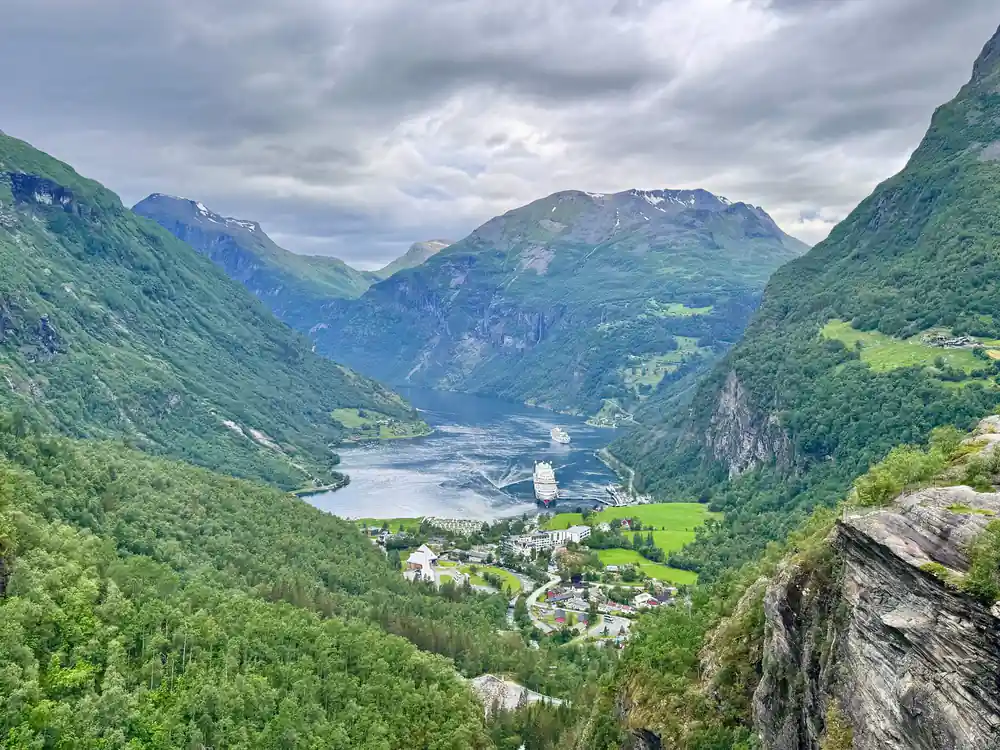
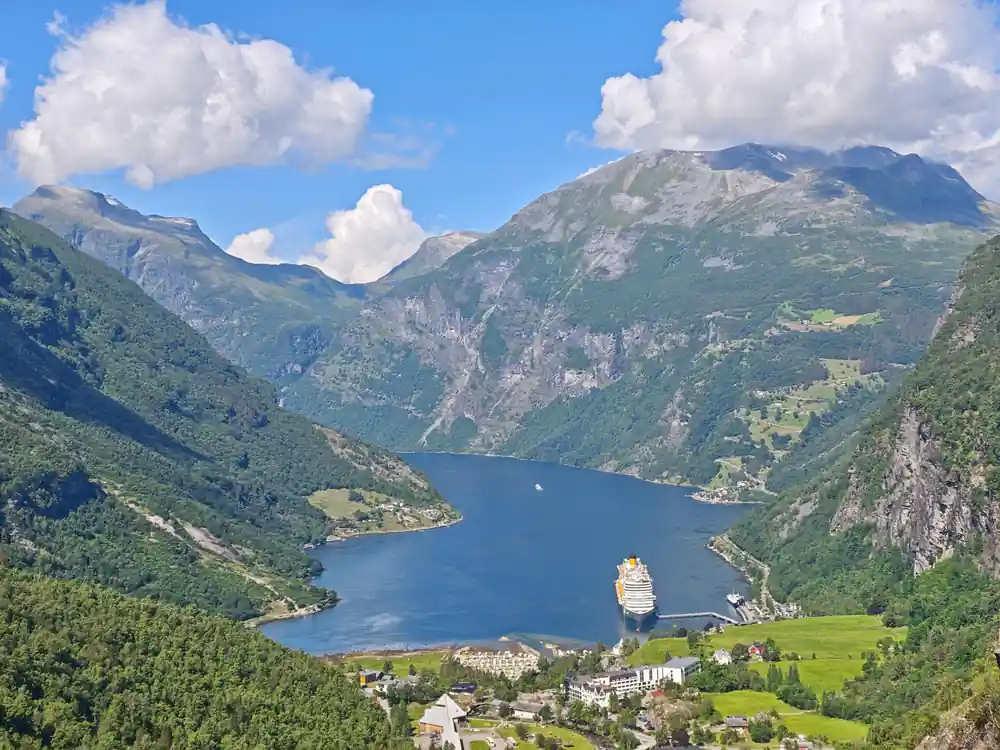
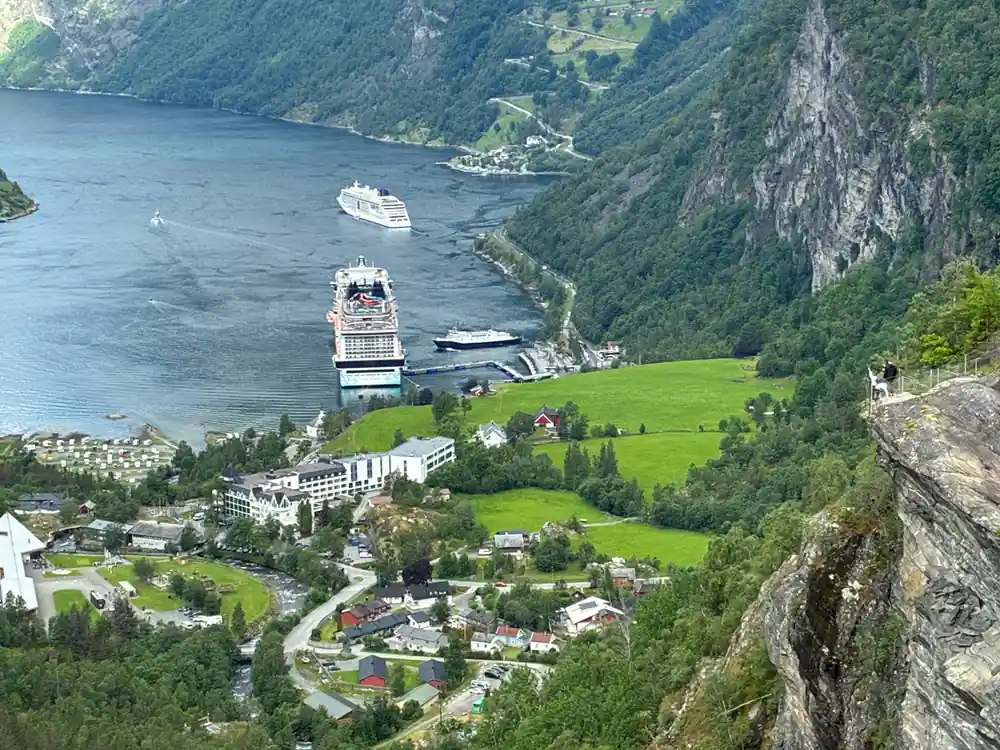
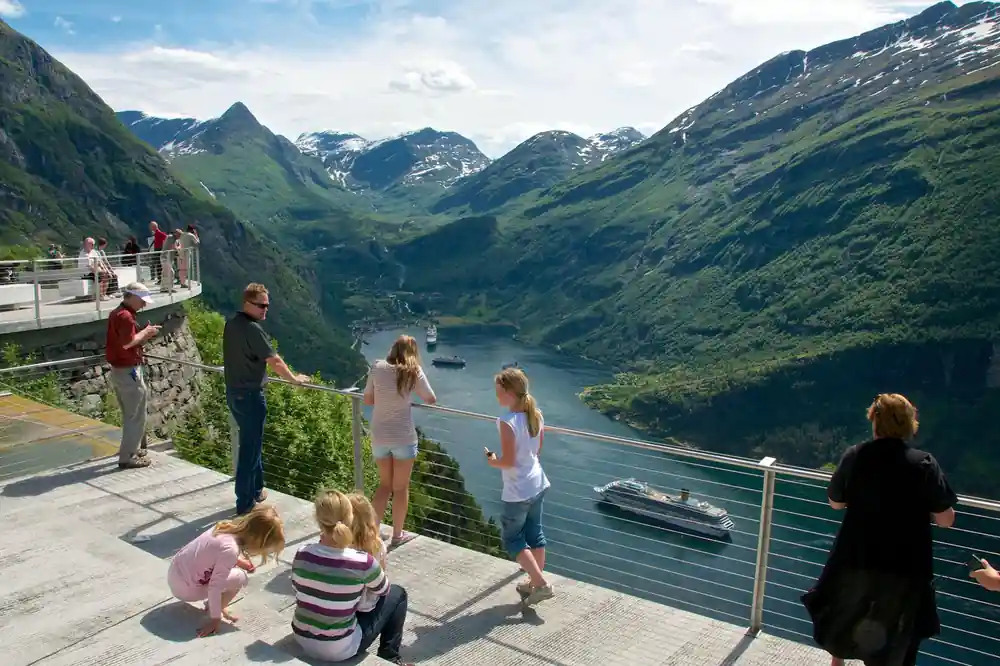
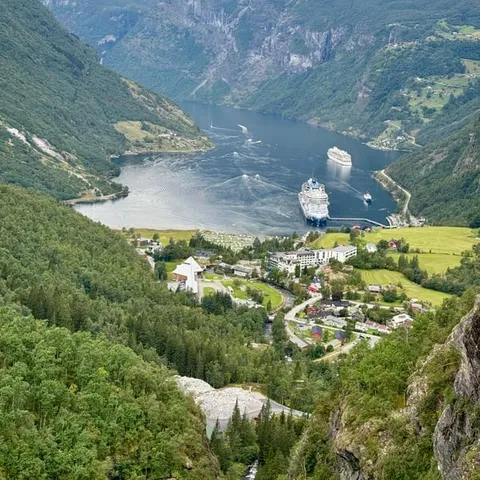
Each stop has its own view. From Flydalsjuvet you look out towards the 1,502-metre Laushornet and the 1,629-metre Eidshornet peaks.[7] The Geiranger Skywalk on Dalsnibba, opened in August 2016, looks straight down to the village, the Geirangerfjord and the Blåbreen glacier.[11] From Ørnesvingen, the highest hairpin of the Eagle Road, the view takes in Geiranger, the fjord, the Seven Sisters waterfalls and the Knivsflå mountain hamlet.[8][9]
Where your guide becomes your conversation partner
How your driver handles the mountain ascent
The hairpin road leading to Dalsnibba is steep, narrow and engineered to switchback tightly up the mountainside. Your driver manages this section as a professional accustomed to the gradient and hairpin turns; passenger comfort and safety during the ascent are standard considerations. The coach is built for Norwegian mountain roads, and the driver times stops at Flydalsjuvet View Point and Eagle Bend to allow you to stretch and photograph without rushing. These stops also serve a practical purpose, breaking up the more challenging sections of the drive and giving the coach's engine and brakes a rest on steep terrain.
Once at the summit, you arrive at the Dalsnibba Skywalk, the highest point of the tour at 1,476 metres elevation. The driver will point out the timing of stops and let you know how long you have at each viewpoint, so you can plan your photography and rest accordingly. The descent follows the same route, with the driver again managing the hairpins and switchbacks with the same professional care.
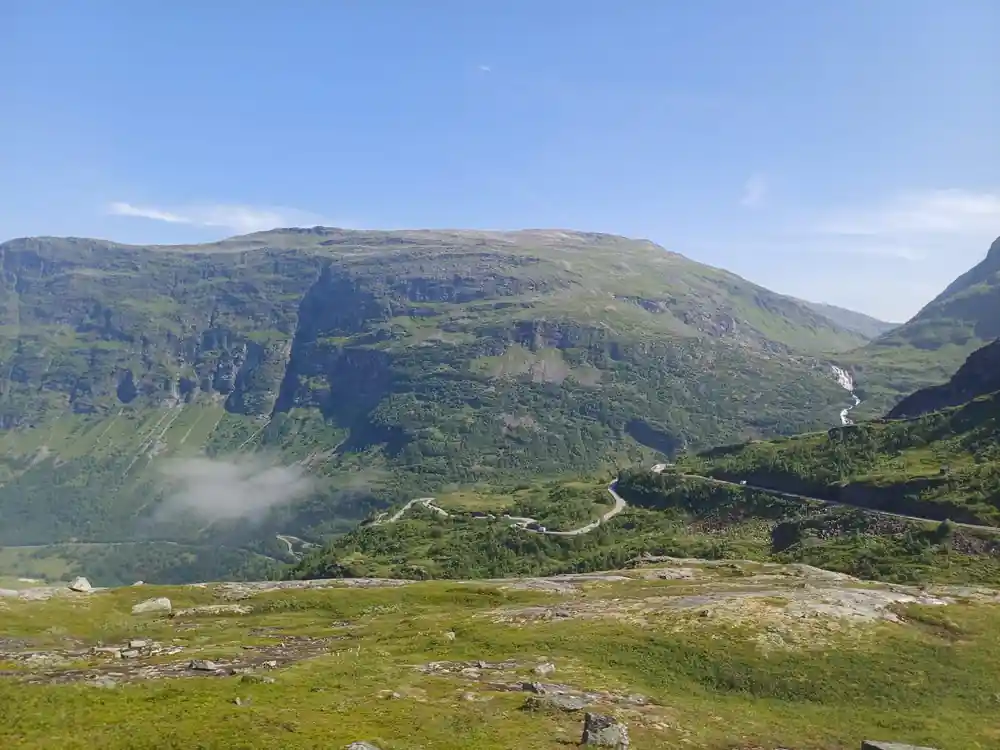
The two roads are the driver's part of the day. The toll road to the top of Dalsnibba starts at Djupvatnet, 1,030 metres up, and climbs through 11 hairpin turns at a 10% incline; it opens in the last half of May and usually closes in late September.[10] Ørnevegen, the Eagle Road, has a one in ten incline at its steepest and takes vehicles up to 15 metres long.[9]
Asking your guide questions at stops
Your guide is available for questions during the stops at Flydalsjuvet View Point, Eagle Bend, Djupvatnet Lake and Dalsnibba Skywalk. These are built into the itinerary specifically to allow you time to take photographs, absorb the views and speak with your guide about what you are seeing. It is normal and encouraged to ask about specific features visible from each vantage point, the names of mountains or waterfalls, and details about the area's history or current conditions. Guides expect and welcome genuine curiosity from passengers.
The best time to ask questions is during the stops themselves rather than while the coach is moving, as this allows the guide to give you full attention and speak without competing with engine noise. If you have specific interests like photography, hiking access to nearby areas, or wildlife in the fjord, mentioning these early in the tour helps your guide tailor commentary to your group where possible. Guides typically remain accessible throughout the stop periods and will help point out features or explain what you are looking at from the viewpoint.
11
Ørnevegen climbs from Geiranger towards Eidsdal in eleven hairpin bends, at one in ten where it is steepest.[8][9]
Tipping guides and drivers in Norway
Tipping is not culturally expected or required in Norway, including for tour guides and drivers. Norwegian service workers, including those in the tourism industry, receive fair wages as standard, and gratuities are not built into the economic model of employment as they are in some other countries. If you receive exceptional service and choose to tip, it is appreciated as a genuine gesture rather than an obligation.
Many international visitors worry about Norwegian tipping norms, but the straightforward approach is to tip only if you genuinely felt the service was exceptional and you wish to express this. Your guide and driver are paid for their work, and you have already paid the tour operator for the guided experience. No one will expect or be offended by the absence of a tip. If your group does decide to contribute something, cash is the most practical method to give directly to the guide or driver.
Visit Norway, the official travel guide, is plain about it: for the most part tipping is not common in Norway, except in bars and restaurants, where tips tend to stay within 5 to 15% of the bill, and whether you tip is entirely up to you. Cards and phone payments are accepted almost everywhere, but Visit Norway still advises a little cash for small purchases, and foreign currency is rarely accepted.[6]
Guides and photography at viewpoints
Guides do not formally assist with photography such as posing you for group photos or operating cameras, though they may offer to take a quick photo if you ask politely during a stop. Their primary role is to provide commentary and manage the group's movement according to the itinerary schedule. However, guides can point out which direction to face for the best light at different times of day, explain which features are most photogenic from each viewpoint, and name the mountains or waterfalls you are trying to capture. This guidance is invaluable for photographers wanting to understand the landscape they are shooting.
At Dalsnibba Skywalk and Eagle Bend especially, the guide will direct your attention to the most striking views and explain why each vantage point is significant photographically. They understand the seasonal changes in light and weather and can advise you on the conditions you are experiencing that day. If you have professional or serious photography interests, mentioning this at the start of the tour helps the guide explain details that matter for composition and understanding the landscape's structure.
Coach facilities and comfort during the tour
The sightseeing coach used for this tour is designed for Norwegian mountain roads and fjord terrain, with large windows positioned to allow viewing and photography from most seats. The coach is comfortable for a 3 hour 30 minute journey, though the ascent to Dalsnibba and descents involve winding roads that may affect some passengers. Windows typically open or can be positioned to reduce glare for photography, and the coach's height gives good vantage points over valleys and fjords. Seating is arranged to accommodate groups, and the guide can usually suggest which seats offer the best views if you have a preference.
Stops are scheduled at four distinct locations, allowing you to exit the coach, stretch and spend time at each viewpoint. The longest stops are typically at Dalsnibba Skywalk and Flydalsjuvet, giving you adequate time to explore, photograph and rest. The driver manages the coach's movement carefully on narrow sections, and passengers with mobility concerns should discuss this with the operator when booking, as getting on and off the coach at each stop is a normal part of the experience.
Facilities along the route are seasonal. The toilets at Flydalsjuvet are open from mid-May to mid-October, and the service house at the top of Dalsnibba has a shop, a café and toilets, with the café open from 09:30 to 18:00 between 15 June and 14 August. Flydalsjuvet and Ørnesvingen are both listed as partially wheelchair accessible.[7][8][10]
Commentary languages on each Geiranger option
Languages offered for the live guide or audio guide on each option, from each operator or listing.[1][2][3][4][5][11]
Price a guided or audio-guided bus day
Every figure is a "from" price for one adult and not a quote. Child prices may differ, so check the listing for your own party before you book.
Timing your guided day
The route, stop by stop
Flydalsjuvet
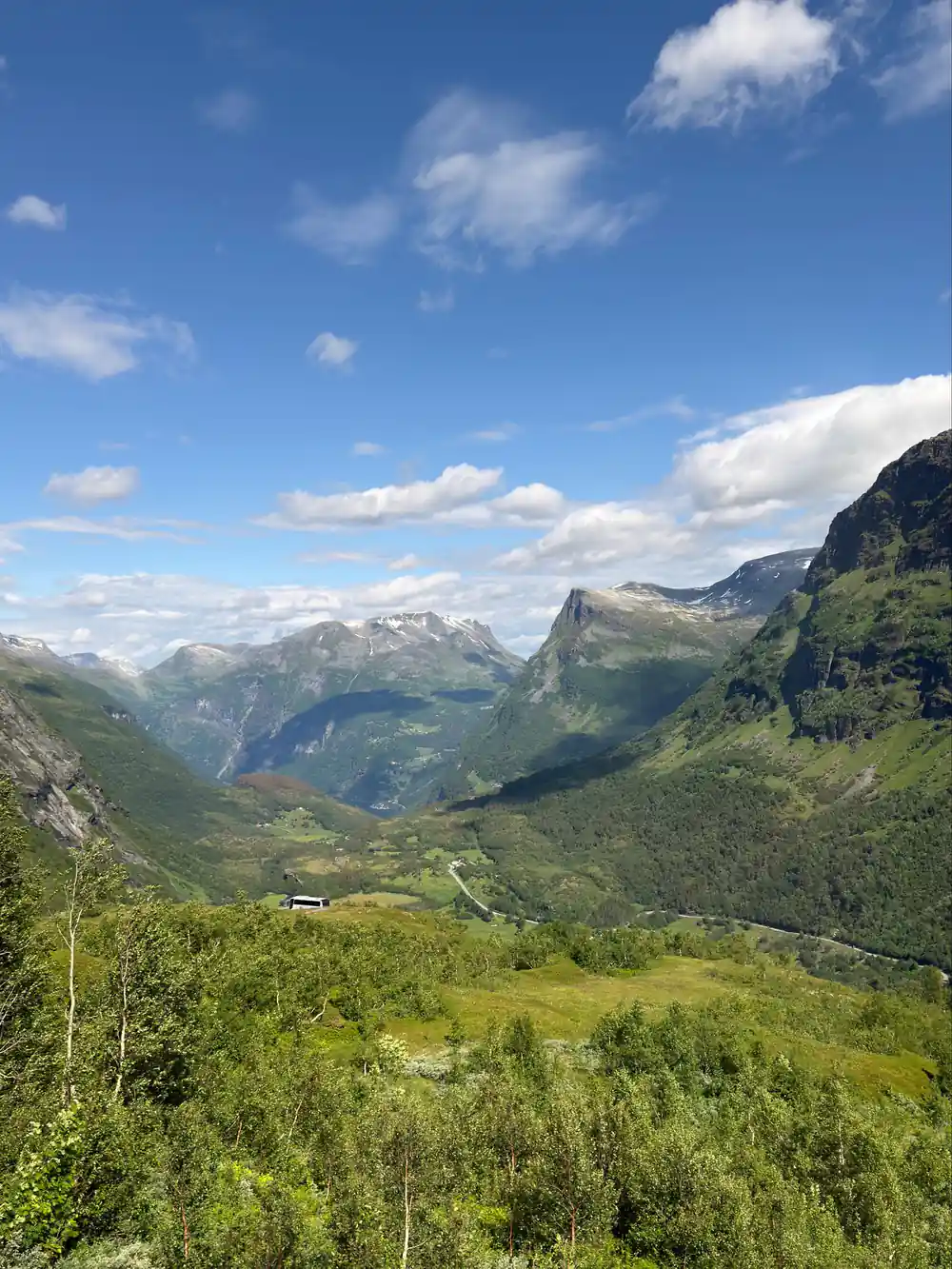
The first stop, looking towards the 1,502-metre Laushornet and the 1,629-metre Eidshornet peaks.[1][7]
Up to Dalsnibba
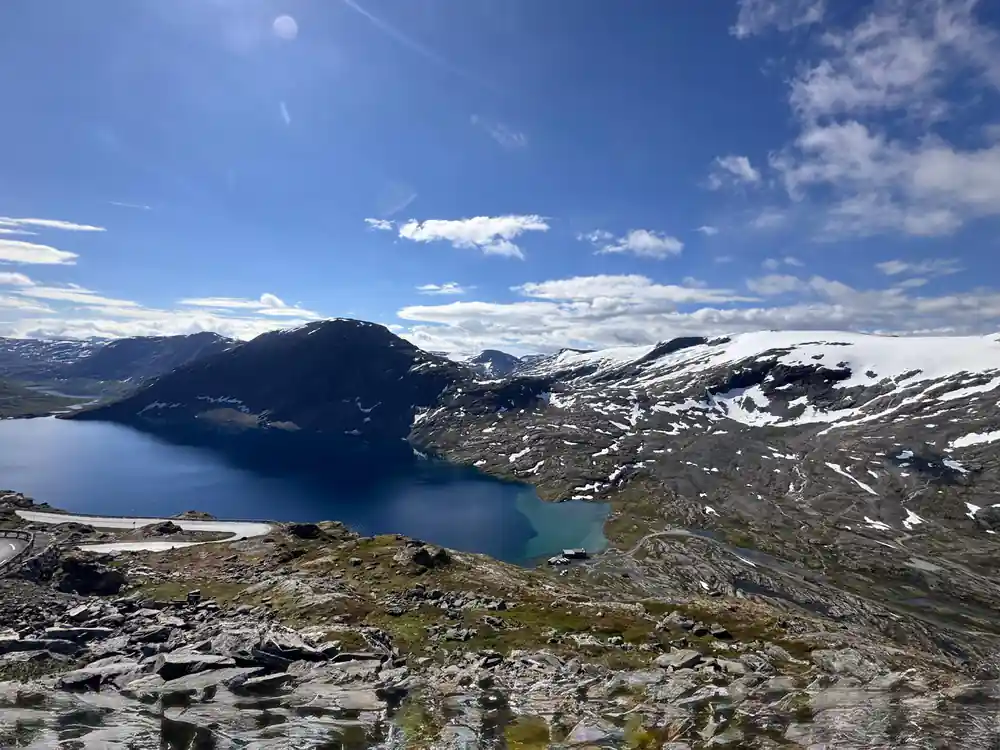
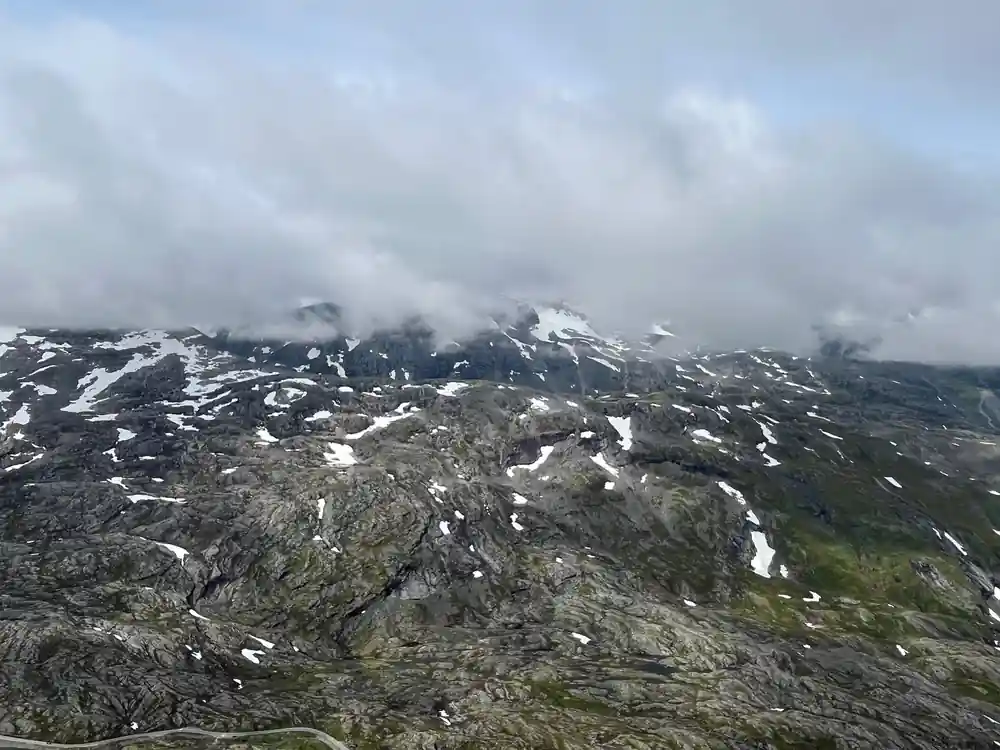
From Djupvatnet the toll road climbs 11 hairpin turns at a 10% incline to the top.[10]
Djupvatnet
The mountain lake at 1,030 metres where the Dalsnibba road begins its climb.[10]
Eagle Bend
The highest hairpin of the Eagle Road, over the fjord, the Seven Sisters and Knivsflå.[8][9]
Ready to explore? Book your live-guided departure
from US$117Reserve now & pay later