At a glance
- Both fjords make up the West Norwegian Fjords World Heritage site, two separate areas about 120 kilometres apart.[5]
- The Geirangerfjord runs 15 kilometres; the Nærøyfjord runs 19 kilometres and narrows to 250 metres in places.[1][3]
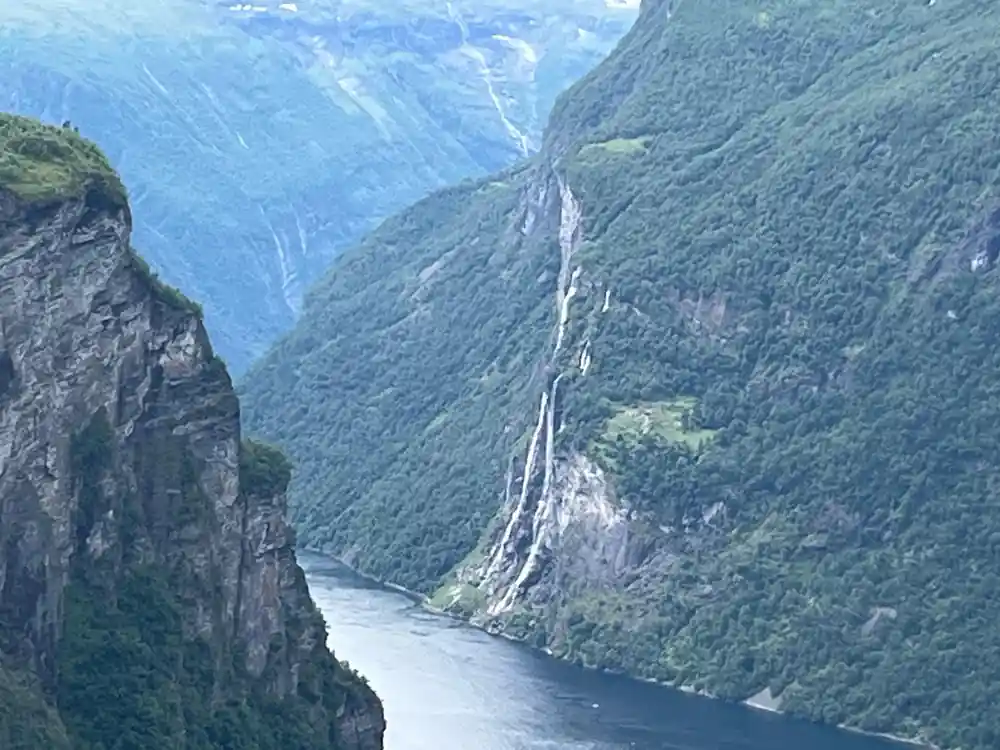
- Seven waterfalls fall into the Geirangerfjord at the abandoned farm Knivsflå, with the Suitor on the opposite side.[1]
- The Nærøyfjord cruise from Flåm to Gudvangen takes about two hours, on a hybrid or a fully electric boat.[4]
- By road Geiranger and Flåm are about 278 km apart, a drive of roughly 4 hours 16 minutes each way.[12]
| Geirangerfjord | Nærøyfjord | Hjørundfjord | |
|---|---|---|---|
| Length | 15 km[1] | 19 km[3] | 21 km[10] |
| Branch of | Sunnylvsfjorden[1] | Aurlandsfjorden, off the Sognefjord[2] | Storfjorden[10] |
| Mountains | 1,400 to 1,700 m[1] | Peaks to 1,800 m[3] | The Sunnmøre Alps[10] |
| World Heritage | Listed in 2005[5] | Listed in 2005[5] | Not in the 2005 listing[5][6] |
| Start from | Geiranger or Hellesylt[6] | Flåm or Gudvangen[3] | Ålesund, on a boat and bus day tour |
| How to see it | Boat, or coach to Dalsnibba | Two-hour Flåm to Gudvangen cruise[4] | Hurtigruten in May or September[11] |
| Recommended for | Named waterfalls and fjord farms | A battery-powered cruise[4] | A shoulder-season sailing |
The West Norwegian Fjords World Heritage Site is made up of two distinct areas approximately 120 kilometres apart on the Norwegian west coast.
The narrow and spectacular Nærøyfjord is surrounded by steep valley sides and snow-covered peaks that rise 1,800 metres above sea level.
Which of the two fjords to visit
Pick Geirangerfjord for
- The Seven Sisters and the Suitor falling on opposite sides of the fjord[1]
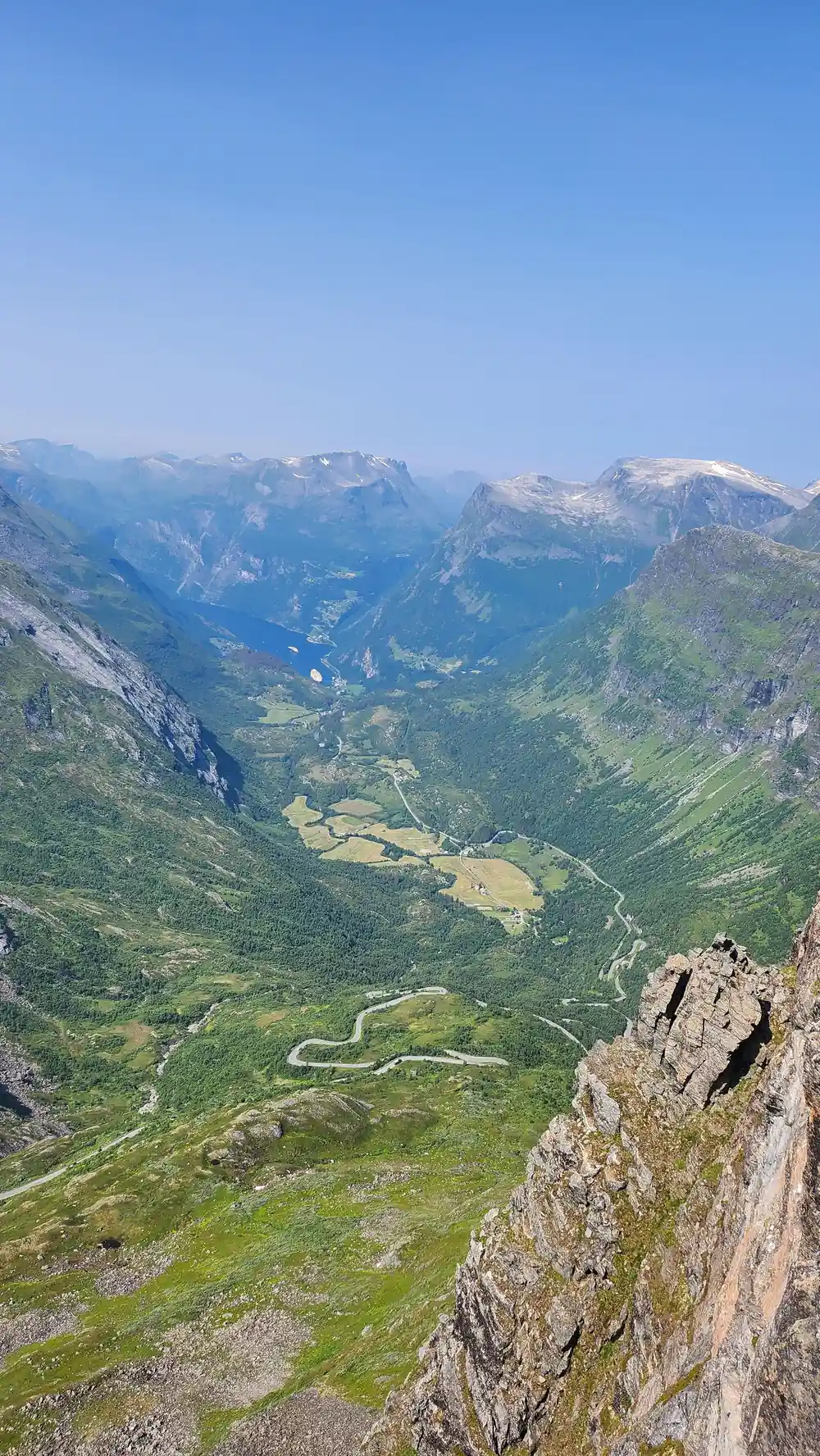
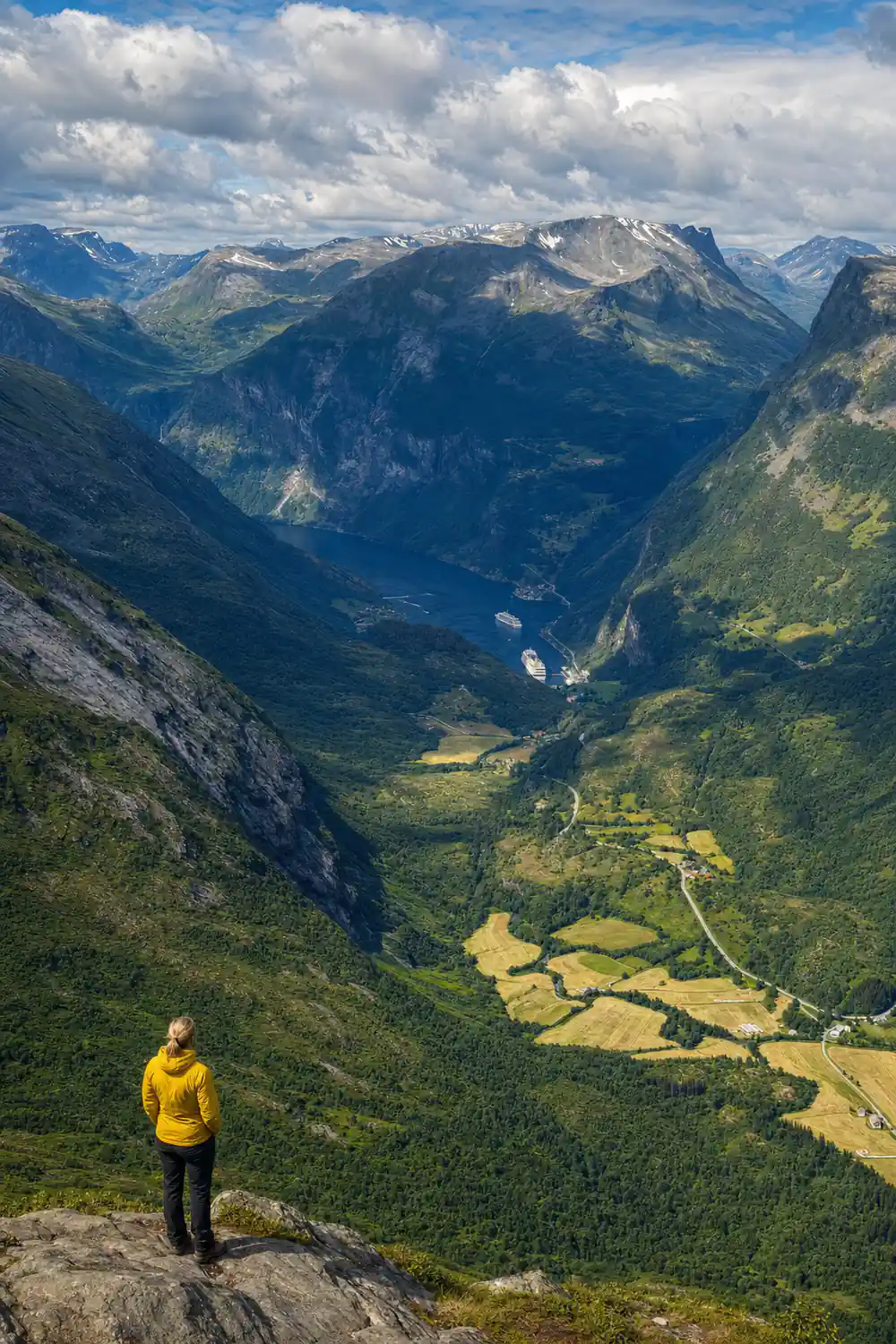
- Views from above at Flydalsjuvet, Dalsnibba and Eagle Bend
- Fjord farms such as Knivsflå and Blomberg high on the walls[1]
- Hurtigruten sailings into the fjord in summer[11]
Geirangerfjord and Nærøyfjord: one listing, two places
The two fjords share a single World Heritage listing. The West Norwegian Fjords were inscribed on UNESCO's list in 2005, and the site is made up of two distinct areas roughly 120 kilometres apart on the west coast: the Geirangerfjord in Sunnmøre and the Nærøyfjord in Aurland, Vestland.[1][2][5] IUCN World Heritage Outlook calls the pair archetypical fjord landscapes, among the longest and deepest in the world.[6]
They were shaped by the same process. During the last Ice Age, glaciers re-moulded the V-shaped valleys into U-shaped valleys with steep mountain sides, and the rock faces now run from the fjord floor to heights of 1,400 metres above sea level.[5] For a visitor, the choice comes down to where you are travelling, how long you have and whether you want to be on the water or above it.
In numbers, the Geirangerfjord is a side arm of the Sunnylvsfjorden, 15 kilometres long and 258 metres at its deepest point.[1] The Nærøyfjord is 19 kilometres long and branches off the Aurlandsfjorden, itself an arm of the Sognefjord.[2][3]
How the two fjords differ on the water
Width is the clearest difference. The Geirangerfjord varies from around 500 to 1,500 metres across, with mountains of 1,400 to 1,700 metres around it.[1] The Nærøyfjord is only 250 metres wide in places, about half the Geirangerfjord's narrowest width, with snow-covered peaks rising 1,800 metres above sea level.[3][4]
For waterfalls, the Geirangerfjord has the named ones. At the abandoned farm Knivsflå seven waterfalls plunge into the fjord, the Seven Sisters, while the Suitor falls on the opposite side and the Bridal Veil sits on the north shore.[1] The Nærøyfjord has several waterfalls down its sides, but the named trio of the Seven Sisters, the Suitor and the Bridal Veil belongs to the Geirangerfjord.[1][2]
Both fjords still have farms. At the Geirangerfjord there are 12 small working farms and 24 with grazing, and the Nærøyfjord area holds 56 small farms.[6] Knivsflå was abandoned as early as 1898, and Blomberg, another abandoned mountain farm and the highest-lying, looks down on the fjord from 450 metres above sea level.[1]
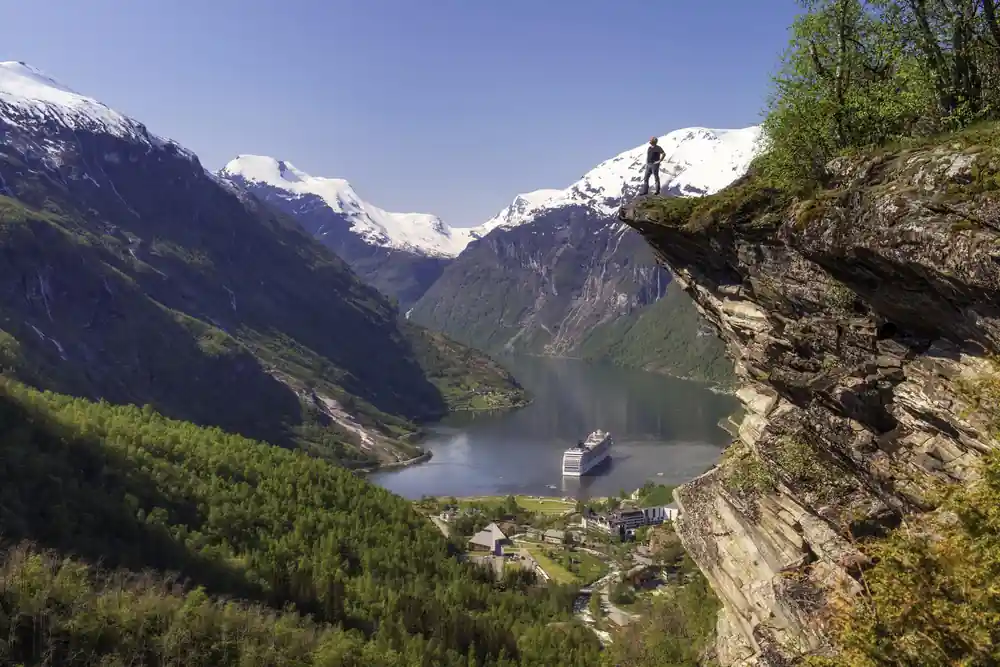
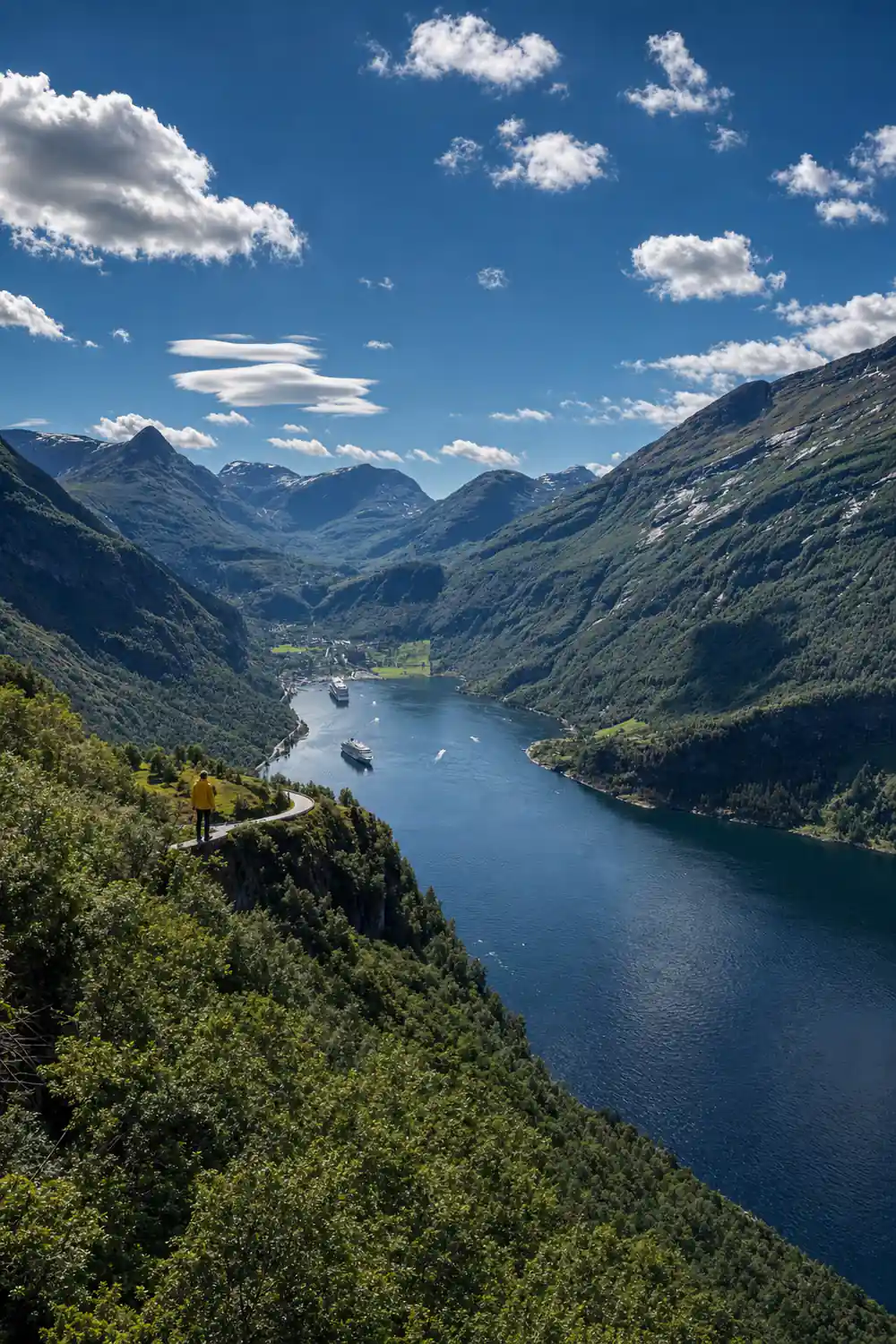
A cruise ship between the steep green walls of the Geirangerfjord
Which fjord is easier to reach
Boats reach the Nærøyfjord from Flåm, Aurland and Gudvangen, and the cruise runs from Flåm through the Aurlandsfjord and into the Nærøyfjord, reaching Gudvangen after about two hours.[3][4] On the classic fjord boats run by Lustrabåtane between Flåm and Gudvangen, an adult one-way ticket is from 550 NOK.[13] A car ferry also links Gudvangen with Kaupanger, RIB safaris run in both winter and summer, and you can also go by kayak.[3]
On the Geirangerfjord side, the cruise ports are Geiranger and Hellesylt.[6] On Hurtigruten's Coastal Express the fjord is a summer detour: from October through April the ship does not go in, and passengers get the day in Ålesund instead.[11] If you are on Hurtigruten outside summer, that timing decides the matter for you.
Seeing both on one trip is possible but takes planning. By road Geiranger and Flåm are about 278 kilometres apart, roughly 4 hours 16 minutes of driving each way, which is more than eight hours for a return trip.[12] Treat them as two separate stops on a longer route rather than one day out.
Which suits a cruise passenger
Geiranger is a busy cruise port. In 2018 the Geirangerfjord received 188 cruise ships and nearly 250,000 cruise passengers, and 178 ships sailed in during 2022.[1] Local port authorities have set a limit of 6,000 cruise passengers a day in Geiranger and Hellesylt.[6] Across the whole World Heritage site, traffic grew from 308 ships and 265,585 passengers in 2002 to 328 ships and 617,545 passengers in 2019.[6]
A port call at Geiranger fits a short excursion. The sightseeing cruise runs 75 minutes or two hours from US$68, and the Dalsnibba coach tour booked from this site runs 3.5 hours from US$116, stopping at Flydalsjuvet, Dalsnibba, Djupvatnet and Eagle Bend. On the Nærøyfjord side, the Flåm to Gudvangen cruise runs on battery power only at under 10 knots along the most exposed stretches of the Nærøyfjord, aboard either the hybrid Vision or the fully electric Future.[4]
The best cruise for Geirangerfjord and Nærøyfjord is one whose itinerary names both a Geiranger or Hellesylt call and a stop on the Sognefjord side, since by road Geiranger and Flåm are about 278 kilometres and over four hours apart.[12] If your ship calls at only one, book the fjord you are given rather than chasing the other.
250 m
The Nærøyfjord narrows to 250 metres in places, while the Geirangerfjord varies from around 500 to 1,500 metres wide.[1][3]
Geirangerfjord vs Sognefjord and the other big names
The Sognefjord is the giant of the group: 205 kilometres long and 1,303 metres deep, the longest and deepest fjord in Norway.[7] Choosing the Nærøyfjord already puts you inside that system, since it branches off the Aurlandsfjorden, an arm of the Sognefjord.[2] The Geirangerfjord, at 15 kilometres, is a far shorter side arm of the Sunnylvsfjorden.[1]
Anyone weighing Geirangerfjord vs Hardangerfjord is comparing very different scales. The Hardangerfjord is Norway's second longest fjord at 180 kilometres, counting the outer Bømlafjorden and the inner Sørfjorden, and its greatest depth of 855 metres was measured off Herand.[8] At 15 kilometres, the Geirangerfjord is less than a tenth of that length.[1]
Lysefjord vs Geirangerfjord is a choice between regions as well as fjords. The Lysefjord lies in Rogaland and runs 42 kilometres, with Preikestolen standing 604 metres above sea level on its north side and Kjerag dropping nearly 1,000 metres straight into the water.[9] For comparison, the mountains around the Geirangerfjord rise to between 1,400 and 1,700 metres.[1]
The Hjørundfjord, the neighbour in the Sunnmøre Alps
Hjørundfjord vs Geirangerfjord is a comparison between neighbours, since both lie in Møre og Romsdal.[1][10] The Hjørundfjord is a 21 kilometre arm of the Storfjorden, reaching south-east into the Sunnmøre Alps, and several of its villages are linked by a ferry route from Hundeidvik and Festøy.[10]
Hurtigruten splits the two by season. Its Coastal Express continues into the Geirangerfjord in summer and turns into the Hjørundfjord in May and September.[11] A May or September voyage therefore shows you the Hjørundfjord, and a summer one shows you Geiranger, although MS Vesterålen visits the Hjørundfjord and not the Geirangerfjord.[11]
You can also see both in a day from Ålesund. The boat tour with a return bus runs 10.5 hours from US$210, and its stops include the Hjørundfjorden, Øye and Norangsdalen before Hellesylt, the Geirangerfjord, Geiranger itself and Ørnesvingen.
Which is less crowded, and which to pick
Most crowd figures cover the World Heritage site as a whole. Visitor numbers for the World Heritage site were recorded at 200,000 in 2021 and 1 million in 2023, and IUCN notes that boat traffic in the Nærøyfjord, including RIB boats and kayaking, may disturb its seal population.[6] At Geiranger and Hellesylt, port authorities cap cruise passengers at 6,000 a day.[6]
If you are deciding Geirangerfjord or Nærøyfjord purely on the scenery, pick by the kind of view you want. The Nærøyfjord gives the narrower water, seen from a boat moving at under 10 knots.[3][4] The Geirangerfjord gives the named waterfalls and the chance to look down on the water from the mountains around it.[1]
On the Geiranger side, the tour sold from this site covers the view from above: 3.5 hours by coach to Flydalsjuvet, Dalsnibba, Djupvatnet and Eagle Bend, with free cancellation. Add the sightseeing cruise, from US$68, to see the Geirangerfjord from the water as well.
How long each fjord runs
Fjord lengths in kilometres; the Hardangerfjord figure includes Bømlafjorden and Sørfjorden.[1][3][7][8][9][10]
Price a day on the Geirangerfjord
Every figure is a "from" price for one adult from each tour's GetYourGuide listing, not a quote. Child prices may differ, so check the listing before you book.
Timing a visit to either fjord
Choosing between the fjords
Find where your trip already goes
Flåm and Gudvangen sit on the Nærøyfjord side; Geiranger and Hellesylt on the Geirangerfjord.[3][6]
Check the distance
By road Geiranger to Flåm is about 278 km, over four hours each way.[12]
Decide water or height
The Nærøyfjord cruise takes two hours; at Geiranger a coach climbs to Dalsnibba and Eagle Bend.[4]
Match the season
Hurtigruten sails into the Geirangerfjord in summer and the Hjørundfjord in May and September.[11]
Book the part on land
At Geiranger, the 3.5-hour coach tour stops at Flydalsjuvet, Dalsnibba, Djupvatnet and Eagle Bend.
See the Geirangerfjord from Dalsnibba and Eagle Bend
from US$117Reserve now & pay later