At a glance
- In Norwegian the name opens with a Y sound, close to YAI-rahng-er, not with a hard G.[25]
- Geiranger counted 215 residents in 2023, on about 0.3 square kilometres of land.[24]
- A weekly steamer from Ålesund began calling in 1858; the first ship carrying tourists arrived on 9 July 1869.[3][4]
- The name probably joins Old Norse geirr, a spear, or geiri, a wedge, to angr, a fjord; the village itself was first called Merok.[24][26]
- Geiranger now takes at most two cruise calls and 6,000 passengers a day.[29]
| 1858 to 1888 | 1889 to 1914 | Today | |
|---|---|---|---|
| Getting in | Weekly steamer from Ålesund[3] | Geirangervegen and horse carriages[26] | Cruise ship, or Ørnevegen all year[26] |
| Visitors | First tourist ship, 9 July 1869[4] | Kaiser Wilhelm II, summers to 1914[26] | 344 cruise calls in 2019[26] |
| Places to stay | One hotel in 1880[26] | Four hotels by 1895[26] | Hotel Union, open all year[28] |
| The village | Called Meråk or Merok[26] | Hotel Union bought by the Mjelvas, 1899[28] | 215 residents in 2023[24] |
| Living from | Two farmers, a cottar, a hotelier[4] | Butter societies, in an 1889 report[6] | Cruise: 257 million kroner in 2024[29] |
There were actually more cars in Geiranger per inhabitant 100 years ago than in New York, and some of these cars are still there.
The hospitable locals started already back then driving royalty and other tourists to viewpoints in horses and carts, and later started transporting them in lovely open-roof cars.
How to see the village and the view it was built on
See in the village
A Name Born from Old Norse Settlement
Geiranger takes its name from the Old Norse word 'Geirr', meaning spear, combined with angr, a fjord.[24][32] The name reflects the Viking heritage of the region and the geography that shaped it: a tight, verdant fjord valley carved by ancient glaciers. Early Norse settlers found in this landscape exactly what the name promised - a sheltered pocket of fertile land nestled between towering cliffs. Today, 215 residents, the 2023 count, carry forward the legacy of those first farmers and traders who saw possibility in this remote corner of western Norway.[24]
The village's identity remains rooted in that past. Street names and local histories echo the Norse connection, and the landscape itself remains largely unchanged from the days when settlers first arrived. Walking through Geiranger village, you encounter not a modern resort but a place where heritage is woven into daily life, where the name itself is a window into centuries of continuity.
The name probably joins Old Norse geirr, a spear, or geiri, a wedge, to angr, a fjord.[24][32] The settlement itself was first written Meråk or Merok, and only after years of heavy tourism did Geiranger alone come into use.[26] As for Geiranger pronunciation, the Norwegian form opens with a Y sound, close to YAI-rahng-er.[25]
What the Topographers Made of the Names
The great topographic survey Norges land og folk worked through Norwegian place names county by county, and it reached these. A number of fjord names, it noted, are compounded with angr, meaning an inlet or a fjord, and Geiranger is one of them [1].
Merok, the village's older name, it treated separately and less certainly. The survey held it related to Meraaker in Stjordalen, pronounced Marrok or Meraak, with the last element akr, a field, and the first probably merr, a mare [2]. A mare's field, in other words, at the head of the most photographed fjord in Norway.
Farming and Fjord Ferries: Life Before the Roads
Before mountain passes opened and bus tours became the norm, Geiranger was sustained by two lifelines: small-scale farming on the steep valley slopes and the seasonal arrival of fjord ferries. Residents cultivated what the cliffs permitted - hardy crops and grazing land that required intimate knowledge of the microclimate. Isolation was total in winter; supplies arrived by water or not at all. The fjord itself was the highway, and the rhythm of the village matched the ferries that connected it to larger towns downstream.
This dependency on the water shaped everything about life here. Families timed harvests and market days around ferry schedules. Winter meant genuine hardship; the snow closed all mountain routes, and the village turned inward. Yet this isolation also preserved a distinct identity. Residents developed deep knowledge of the fjord's moods, the best fishing grounds, and how to live within seasonal extremes. That knowledge persists even now, even as the village has transformed utterly.
The first scheduled link was a boat: from January 1858 a steamer ran from Ålesund once a week.[3] Geirangervegen was finished in 1889, and horse-drawn carriages then carried travellers on to Grotli and Otta.[26][38] Between the wars around 50 cars worked the hire trade.[26] Ørnevegen, the road over to Eidsdal, was officially opened on 15 September 1955.[39]
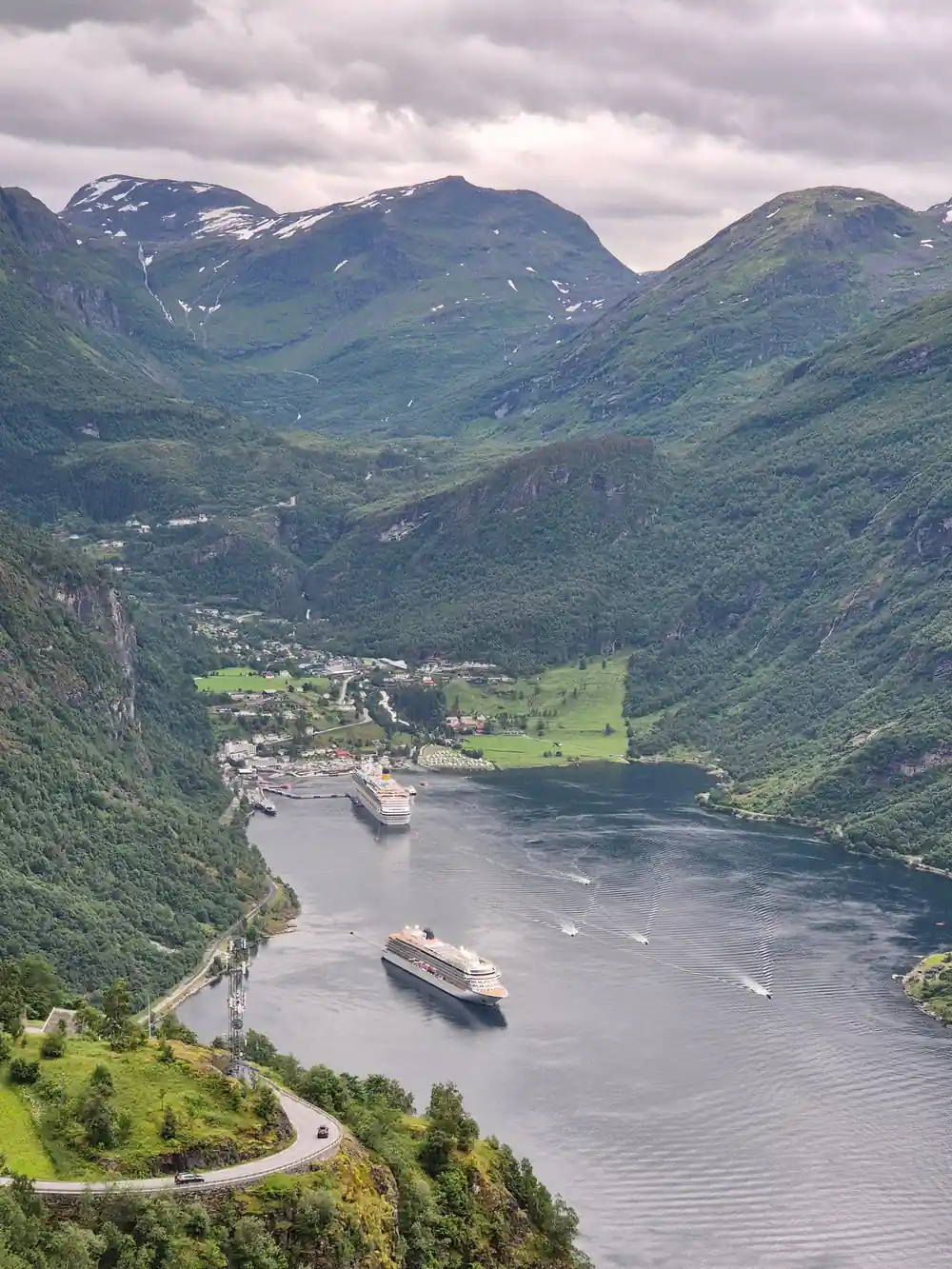
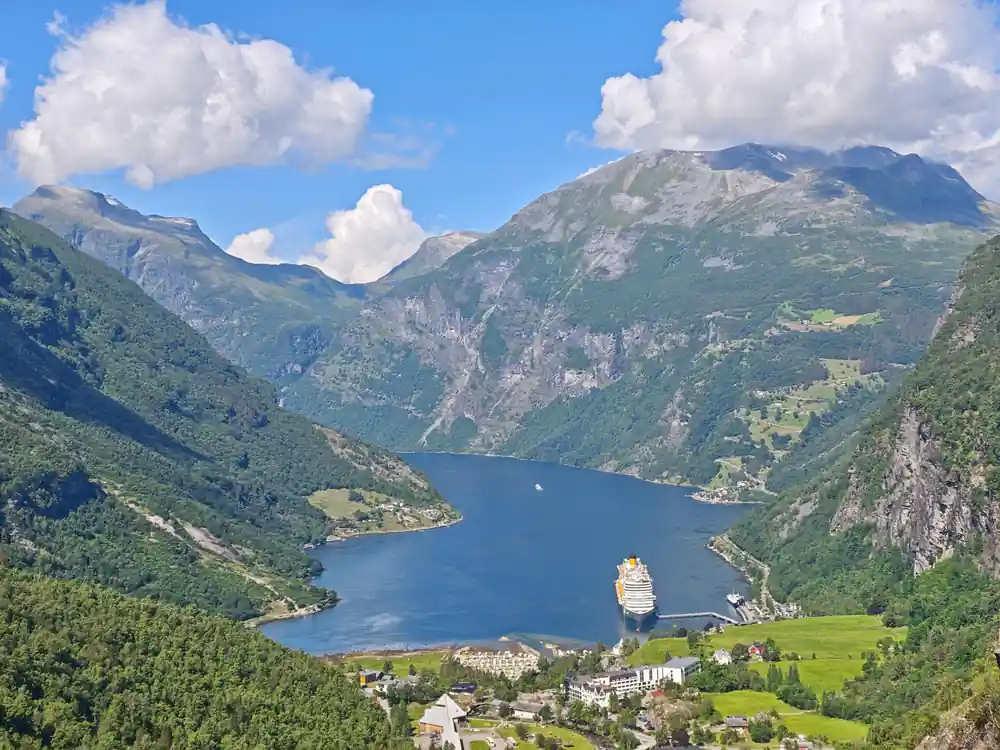
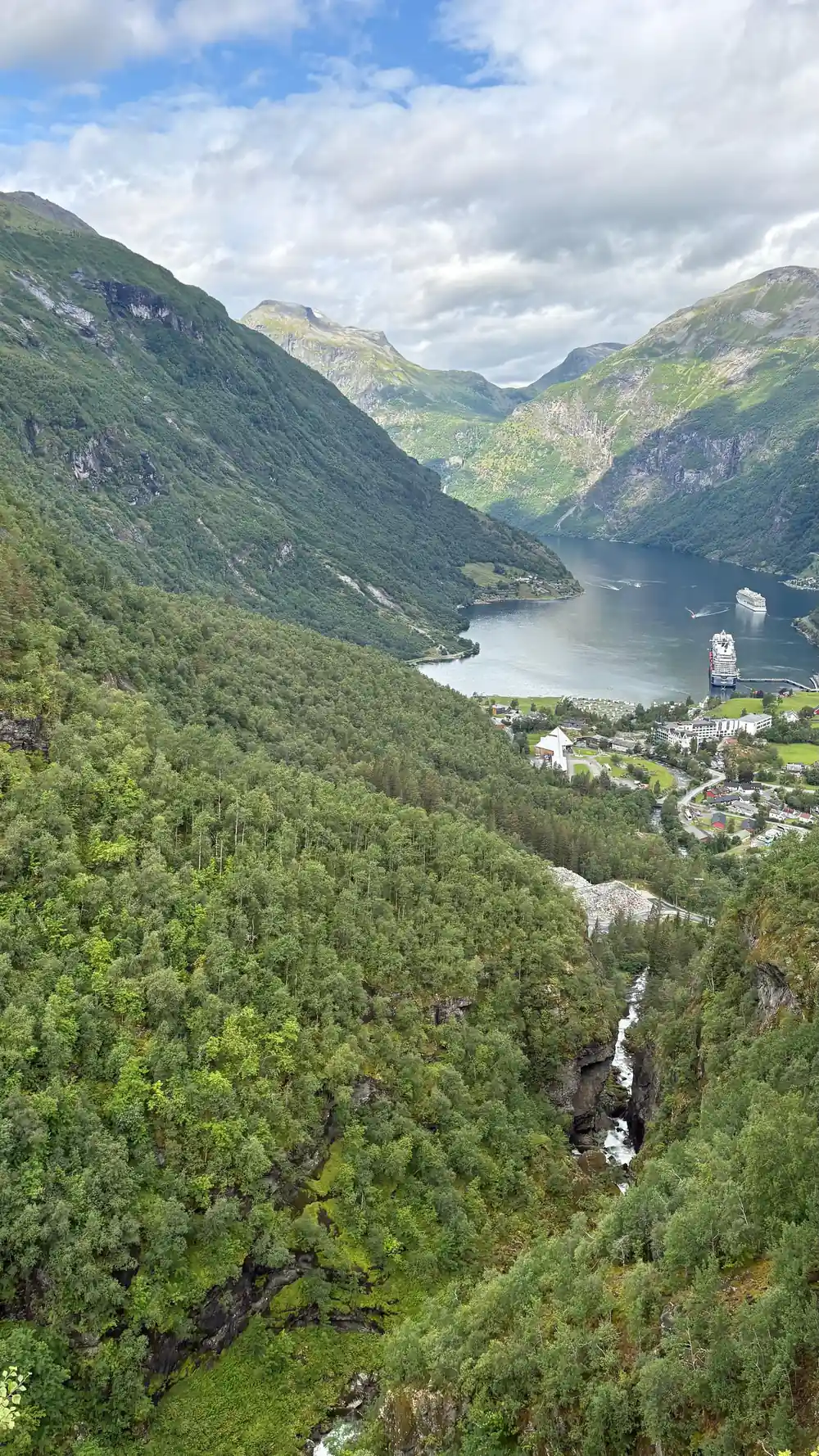
The head of the Geirangerfjord, where the settlement was first written Meråk or Merok
Royal Visitors and the First Tourist Steamships
The turning point came in the 19th century when Norway's royal family discovered the Geirangerfjord and early tourist steamships began charting routes along the coast. What had been a remote farming village suddenly appeared in travel journals and guidebooks. The first tourists arrived on 9 July 1869 in an English pleasure yacht, towed in by a small steamboat.[4] Royal endorsement gave the place prestige; word spread that this was a destination worthy of the journey.
These early visits established Geiranger as something new: a tourist attraction. Local families began taking in visitors, offering simple accommodation and meals. The infrastructure of tourism - guesthouses, guides, viewpoints - began to emerge organically from hospitality rather than corporate planning. By the early 20th century, Geiranger had become known throughout Europe as one of Norway's finest fjord destinations. The foundation laid by those first steamships remains visible today in the village's character and its relationship to the wider world.
Kaiser Wilhelm II of Germany arrived by ship in 1899, thirty years after the first tourists, which was good publicity for the village, and came back every summer until 1914.[26] One hotel stood in the village in 1880 and four were open by 1895.[26] Hotel Union opened in 1891, and Julie and Karl Mjelva bought it in 1899; the Mjelva family has run it for four generations since.[28]
The First Boat, and the First Tourists
The dates are in books rather than newspapers, and they are earlier than most visitors assume. A history of Stranda records that from January 1858 a scheduled boat ran from Aalesund to Geiranger once a week, the first being the paddle steamer Sondmor [3]. A description of Geiranger written in 1905 by E. R. Hole, who lived there, gives the arrival precisely: the steamship reached Geiranger on 30 January 1858 and left again the following morning [4].
Tourists came eleven years later. The same book records that the first ship carrying tourists reached Geiranger on 9 July 1869, and that it was an English pleasure yacht, towed in by a small steamboat [4]. Hole also noted that some thirty years before he wrote, Merok held two farmers, one cottar, and the man who owned the hotel [4].
The Winter Silence: Geiranger Fjord in Deep Snow
Winter transforms the Geirangerfjord Norway landscape into something almost unrecognizable. The snow falls heavy and relentless, piling against the steep cliffs and filling the passes that lead out of the village. Temperatures drop well below freezing; the fjord waters become slate-gray, reflecting a pale sky that barely brightens in the short days of December and January. The waterfalls that pour down the cliff faces in summer freeze into sculptural formations of ice and snow. The village itself seems to contract, as if drawing inward against the cold and silence.
This is the season when the village is truly isolated again. The tourist season ends; most businesses close. Locals and a handful of year-round residents settle into a quieter rhythm. At night, the stars above are extraordinary in their clarity, unmarred by the ambient light that summer crowds bring. The fjord becomes a landscape of extremes - beautiful, severe, and utterly still. For those who stay, winter is a reminder of what Geiranger was for centuries: a place apart, where the seasons ruled absolutely.
The winter isolation has a precise shape. Geirangervegen closes and the Hellesylt ferry usually stops sailing, which leaves Ørnevegen, the road from Eidsdal, as the only year-round way in.[26] On the high section between Djupvasshytta and Langvatn the closure normally begins in November, and the road reopens around 25 May, depending on avalanche and weather conditions.[38] Anyone planning a Geirangerfjord, Norway, winter trip should plan to arrive over Ørnevegen. Hotel Union keeps its rooms open all year.[28]
2019
Geiranger took 344 cruise calls in 2019, more than any other port in Norway, and had 215 residents in 2023.[24][26]
The Summer Crush: Managing a Million Visitors
The contrast between winter and summer could hardly be starker. Starting in May and intensifying through July and August, the village receives an estimated one million visitors annually. Cruise ships anchor in the fjord; tour coaches line the narrow roads; hiking trails fill with people from every continent. The 215 residents counted in 2023 are outnumbered many times over.[24] Hotels that sit empty in February overflow; restaurants operate at full capacity; the quiet roads become congested with traffic.
Locals have developed strategies for coexistence. Some embrace the season, working in tourism and hospitality. Others maintain strict boundaries between their private lives and the public spaces tourists occupy. Community leaders have worked to preserve core parts of village life from commercialization. There is tension, certainly, and an understanding that summer prosperity comes with a cost in peace and solitude. Yet there is also recognition that tourism funds the schools, maintains the infrastructure, and makes year-round residence viable for those who choose it. The summer surge is the price and the benefit of living in one of Norway's most celebrated landscapes.
Geiranger took 344 cruise calls in 2019, more than any other port in Norway.[26] Cruise tourism brought Stranda municipality just over 257 million kroner in 2024.[29] The port now caps Geiranger at two cruise calls and 6,000 passengers a day.[29] Ships under 10,000 gross tonnes must be emission-free in the World Heritage fjords from 1 January 2026, and larger ships from 1 January 2032.[30]
Geiranger at Night: A Village After the Crowds Depart
As evening falls and the tour coaches leave, Geiranger returns to something closer to itself. Restaurant crowds thin; the hiking trails empty; the fjord settles into evening calm. At night, the village reveals a quieter character. A few lights glow in windows; the sound of conversation drifts from open doors; the cliffs emerge as dark silhouettes against the twilight sky. This is when locals emerge to reclaim their streets, to walk without navigating around camera-wielding tourists, to sit in cafes where the pace slows.
Summer nights are not silent as winter nights are, but they carry a different quality than daytime hours. The temperature drops; the air becomes fresh and clean off the fjord. If the sky is clear, you may see the northern lights dancing in the distance, though true aurora borealis is more common in the long dark months. The experience of Geiranger at night, away from the daytime throngs, offers glimpses of the genuine life that persists beneath the tourism infrastructure - a life that is older, quieter, and fundamentally rooted in the place itself.
How to Experience the Real Geiranger
Visiting Geiranger does not require joining the cruise ship masses or following the established tour routes, though these remain popular options. Staying for multiple days allows you to experience the rhythm of the village across different hours. Arrive before 8 a.m. or after 5 p.m., when the day-trip crowds are absent. Eat in local restaurants that serve residents as well as tourists; ask staff where they actually go on their days off. Walk the smaller trails that do not appear in every guidebook. Spend time simply sitting by the fjord, observing light and weather across hours rather than minutes.
Consider visiting in late spring or early autumn, when the weather remains pleasant but the summer crush has passed. Speak with locals if the opportunity arises; most have compelling stories about life in this transformed landscape. Stay in family-run accommodations where hosts can point you toward genuine local experiences. The village rewards patience and curiosity. Geiranger's official attractions are worth seeing, but the deeper experience comes from recognizing that you are visiting a place where real people live, work, and maintain continuity with centuries of history.
The human story of the fjord is laid out a kilometre from the centre at the Norwegian Fjord Centre, reached on foot by 327 steps and an 85-metre climb; adult tickets cost from NOK 160.[31] Its exhibition on the history of the fjord people was unveiled by Queen Sonja on 6 September 2025, and Storfjordens Venner, founded in 1975, has restored more than 150 fjord farms.[31] From above, the tour booked from this site stops at Flydalsjuvet, Dalsnibba, Djupvatnet and Eagle Bend in 3.5 hours.[33]
Years after the first steamer of 1858
Counted from the first scheduled steamer in January 1858.[3][4][24][26][28]
What a day around Geiranger village costs
Each figure is a "from" price for one adult from the operator's listing, not a quote. Child prices may differ, so check the listing for your own party.
Timing a visit to the village
A morning in the village
Start at the church
Geiranger Church is octagonal, built of timber in 1842, and seats 120.[27]
Walk up to the Fjord Centre
A kilometre from the centre, 327 steps and 85 metres up; adults from NOK 160.[31]
Pass the hotel of 1891
Hotel Union has been run by the Mjelva family since 1899.[28]
Board the coach
Flydalsjuvet, Dalsnibba, Djupvatnet and Eagle Bend in 3.5 hours.[33]
Look back from Flydalsjuvet
The best-known tourist view of Geiranger, reached along County Road 63.[24]
See Geiranger the way locals do
from US$117Reserve now & pay later